Since the 1970s, the state building and fire codes have regulated certain aspects of building construction and remodeling. Because both codes contain fire protection provisions, some policy makers have expressed concern that building and fire officials develop, apply, or interpret similar provisions differently. With the backing of the Minnesota State Fire Chiefs’ Association, legislation was introduced during the 1997 session that would have transferred building code responsibilities from the Department of Administration to the Department of Public Safety, where proponents thought that conflicts among codes and officials could be resolved more cooperatively. Other policy makers have questioned how well the building code is administered on the state level and whether there is a conflict of interest in having the Department of Administration responsible for both enforcing the building code and managing state building construction.
In April 1998 the Legislative Audit Commission directed us to examine how the building code is administered on the state level and its relationship with the fire code. We focused on the following major research questions:
To what extent have cities and counties adopted the state building code?
Is the process for developing and adopting the state building code reasonable, consistent, and timely?
What does the Department of Administration do to help ensure that the state building code is being enforced consistently?
How do other states adopt, organize, and administer their codes? Should building and fire code administration in Minnesota be reorganized?
To answer these questions, we collected data on the operations, policies, and procedures of the various state agencies that are involved in administering the building and fire codes. We interviewed officials in other states to learn how they organize code responsibilities. We contacted 45 interest groups to help identify problems related to state-local relationships and make recommendations for change. We reviewed the literature on model codes and practices, as well as Minnesota statutes, rules, and the building and fire codes themselves. Finally, we attended meetings of various advisory groups that are involved in developing or examining the state building code.
Minnesota statutes require that the Commissioner of Administration adopt minimum standards for building construction and remodeling that govern structural materials, design and construction, fire protection, health, safety, and sanitation. The purpose of these standards, which collectively make up the state building code, is to help protect the health and safety of the state’s residents while containing construction costs.
Practically speaking:
The state building code is actually a compilation of numerous individual codes that have been developed by both state agencies and national organizations.
The state building code sets requirements in numerous areas, including accessibility, construction, electricity, energy, fire protection, mechanical components such as elevators, and plumbing. Some of these provisions are based on nationally-developed model codes, such as the Uniform Building Code, the National Electrical Code, and the Uniform Mechanical Code, usually amended to reflect Minnesota’s unique concerns. Other provisions, such as the code’s energy and plumbing provisions, are "homegrown" in that state agencies develop them independently and do not adopt and amend any single national model code. Regardless of their origin, various building code provisions are often closely related to one another. For example, the energy provisions of the building code deal with some of the same subject matter as the code’s mechanical provisions.
In addition:
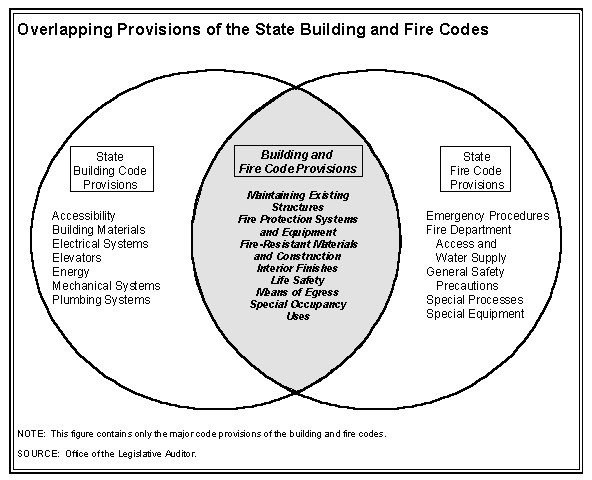
For example, as shown below, the state building and fire codes both contain fire protection provisions. Generally speaking, the building code sets construction requirements that are enforced while a building is under construction, and the fire code sets use and maintenance requirements that are enforced once a building is occupied. Both codes are based on national model codes, the Uniform Building Code and the Uniform Fire Code, that are designed to be companion documents. As a result, the state building and fire codes frequently reference one another. However, unlike the state building code which must consider cost factors, statutes do not specifically require that the fire code be "cost-conscious." <FN- According to the Department of Public Safety, cost is one of several factors that the department considers when promulgating the state fire code.>
Minnesota has had a state building code for over 30 years, although the geographic and structural applicability of the code has changed considerably in that time. The Legislature adopted the state’s first building code in 1965, but required only that it be applied to state-owned buildings. In 1971 the Legislature mandated that the building code supersede existing municipal codes, citing high construction costs caused by a multitude of local codes and ordinances. The Legislature made the building code mandatory statewide in 1977, calling for both state and local enforcement. However, in a reversal, the 1979 Legislature allowed counties outside the seven-county metropolitan area to opt out of the code by referenda and, two years later, it permitted small cities (fewer than 2,500 residents) in code-adopting, nonmetropolitan counties to opt out also. Currently:
Statutes require that all counties in the seven-county metropolitan area adopt the state building code. Ten other counties in southeastern Minnesota and about 170 cities and townships throughout the rest of the state have voluntarily adopted the building code. Although only 20 percent of the state’s counties, 44 percent of its cities, and 12 percent of its townships are covered by the building code, about 80 percent of the state’s population live in these jurisdictions.
The building code covers all new construction, except for agricultural buildings that are designed, constructed, and used to house farm implements, livestock, or agricultural products. The code also applies to existing buildings that are being remodeled, rehabilitated, or altered. However:
These include buildings paid for by the state and all public school building projects that cost at least $100,000. Certain state-licensed facilities, like nursing homes, hospitals, and supervised living facilities, must also meet building code requirements regardless of location. The building code does not cover federal buildings, nor does it cover local government buildings in jurisdictions that have not adopted the building code.
In addition:
All nonagricultural buildings throughout the state must comply with the accessibility, electrical, elevator, manufactured home, plumbing, prefabricated and industrialized/modular building, and storm shelter provisions of the building code. <FN- The electrical provisions apply to all buildings, including agricultural buildings, statewide. The plumbing provisions apply to all buildings, including agricultural buildings, statewide except nonpublic buildings with private water and sewer connections.> In addition, buildings throughout the state must comply with the state fire code which contains some of the same fire protection provisions as the building code.
Finally:
Statutes require that the building code must be written as much as possible in terms of desired results rather than specifying the means to obtain those results. Thus, the code encourages builders to seek new ways to achieve its goals, and building officials are given wide latitude to grant "equivalencies" that allow builders to achieve the code’s goals in diverse ways. Statutes define equivalencies as measures other than a code requirement that provide essentially the same protection that would be provided by a code requirement.
Although Minnesota statutes give the Department of Administration the overall responsibility for promulgating the state building code, we found that:
Four different agencies develop or adopt different building code provisions. The Department of Administration is responsible for developing and adopting the accessibility, construction, fire protection, and mechanical code provisions. The State Board of Electricity and the Department of Health are responsible for developing the code’s electrical and plumbing provisions respectively, but the Department of Administration formally adopts them and retains the authority to modify them prior to adoption. In contrast, statutes give the Department of Public Service the authority to independently develop and adopt energy rules that the Department of Administration must subsequently fold into the state building code. The Department of Administration does not have the authority to modify the energy code provisions that are adopted by the Department of Public Service.
As long as these agencies develop or adopt unrelated code provisions, there are likely to be few problems. However, we found that:
During code development, agencies must understand how proposed changes in one provision affect other building code provisions as well as similar provisions in related state codes. When promulgation authority is located in separate agencies, there are more opportunities for inconsistent language. For example, there have been few problems among the construction, electrical, and plumbing provisions of the building code, partly because the Department of Administration has ultimate adoption authority for these provisions. However, several new energy code provisions that the Department of Public Service recently adopted are inconsistent with proposed changes to the code’s mechanical provisions being developed by the Department of Administration. And, as we discuss later, the departments of Administration and Public Safety have had numerous problems developing and adopting the overlapping provisions of the building and fire codes.
We looked at the time that has elapsed between the availability of model codes and the adoption of those codes and their amendments and found that:
For the most part, adopting model codes with no state amendments has taken the least amount of time. For example, the Department of Administration adopted the National Electrical Code without amendments only 11 months after it was initially published. In contrast, it has taken much longer to adopt amended model codes. For instance, we have estimated that it will take the Department of Administration more than two years to promulgate the latest mechanical provisions of the building code, partly because the department must ensure that these provisions are consistent with similar requirements in the code’s energy provisions. Likewise, amending and adopting the most recent construction provisions of the building code took about one and a half years.
Other states with similar code provisions have timelines comparable to those in Minnesota. Wisconsin took about nine months to adopt the model electrical code, similar to Minnesota. Iowa and Michigan reported taking about two years to adopt their model construction code provisions; Rhode Island and Virginia required about a year. According to a 1993 study by the Minnesota Department of Administration, most other states took less than two years to adopt a model code with or without amendments.
Despite an acceptable timeframe for adopting some code provisions:
For example, the building code’s energy provisions promulgated by the Department of Public Service address some of the same subject matter as the code’s mechanical provisions. Although the Department of Administration is ultimately responsible for enforcing the energy code provisions, it did not formally participate on the Department of Public Service’s code advisory committee. Shortly before the energy provisions were adopted in July 1998, the Department of Administration began developing new mechanical code provisions, but did not formally involve the Department of Public Service on the mechanical code advisory committee. At that time, the Department of Administration questioned how building officials would enforce some of the new energy provisions and how inconsistent requirements among the code’s construction, energy, and mechanical provisions would be resolved. Consequently, the Department of Public Service decided to re-open the rulemaking process to amend certain energy provisions. Likewise, Department of Administration staff said that they may re-open the rulemaking process to amend the construction provisions of the building code.
Just as good coordination is necessary when different agencies promulgate different provisions of the same code, good coordination is critical when agencies with different philosophies and priorities promulgate separate codes that address the same subject matter. We found several problems between the recently adopted state building and fire codes. The Department of Public Safety adopted the state fire code in June 1998 even though the department had not resolved all of its differences with the Department of Administration. This forced the Department of Administration to delay adopting the building code so that staff could include some fire protection provisions that they did not entirely agree with in the building code. Although both departments contributed to this complicated and frustrating sequence of events, such problems are likely to recur without better coordination.
Just as the responsibility for developing and adopting building code provisions is divided among several state agencies, responsibility for enforcing the code is divided among various state agencies as well as local government. We found that:
According to statutes, the State Building Official in the Department of Administration oversees enforcement of the state building code. Statutes authorize the Department of Administration to direct and supervise other state agencies enforcing various provisions of the building code in some public buildings, including the State Board of Electricity and the departments of Health and Labor and Industry. Municipalities that have adopted the building code are responsible for enforcing it in all other buildings in their jurisdiction. These municipalities also have the responsibility for enforcing the building code in some public buildings if the Department of Administration determines that they have the necessary resources.
In addition to the numerous state agencies enforcing the building code, the State Fire Marshal has interagency agreements with four state agencies (the departments of Children, Families & Learning; Corrections; Health; and Human Services) to conduct plan reviews and inspections of public schools and state-licensed facilities for certain fire protection provisions of the state fire code. These provisions largely overlap with the fire protection provisions of the building code.
This complex, and at times duplicative, enforcement structure has not always worked smoothly. We found that:
While building officials are responsible for a building during the construction phase, fire officials assume responsibility immediately after the certificate of occupancy has been issued. However, building officials have granted equivalencies for certain building code provisions that overlap with the fire code without routinely informing fire officials. As a result, fire officials, unaware of these equivalencies, have determined that some public buildings have not complied with the fire code.
Finally, we noted that:
Although statutes provide that the State Building Official must assume local enforcement responsibilities if the Commissioner of Administration determines that a municipality is not enforcing the building code properly, this has rarely happened. Statutes only permit the Commissioner to remove a local building official; intermediate alternatives are not available. As such, this authority may be "too blunt a sword" to be an effective means of discipline. Also, the Department of Administration does not routinely collect information about local building officials’ activities or the status of most buildings in code-adopting jurisdictions.
Finally, building officials have wide latitude to grant equivalencies that allow designers and builders to achieve the building code’s goals in different ways. However, since equivalencies are granted by building officials and only apply to a specific project, the same option may not be available to builders in other municipalities. The Department of Administration does not have the authority to require that local officials accept an equivalency or the department’s code interpretations, regardless of whether officials in other municipalities have accepted them.
Because local building officials have considerable discretion in allowing equivalencies and interpreting the building code, it is important that designers and builders have the chance to have local decisions reviewed by an independent but qualified person or group. We found that:
The Uniform Building Code, upon which the state building code is based, requires that all municipalities establish local boards of appeals. Minnesota statutes provide that anyone disagreeing with the final decision of a municipality may appeal that decision to the Commissioner of Administration, who must follow contested case procedures to hear the appeal. The commissioner’s decision may be appealed to the courts.
According to Department of Administration staff, a small percentage of code-adopting municipalities have established local boards of appeals. There have been no formal appeals to the Commissioner of Administration in the last several years. Although the state building code requires that local boards of appeals send a copy of their decisions to the Department of Administration, department staff indicated that they have received few such reports over the last several years.
In contrast, Minnesota statutes have established an intermediate appeals mechanism for the fire code in the State Fire Marshal Division. Like the building code, the fire code requires that local municipalities have local boards of appeals. However, local decisions can be appealed to the State Fire Marshal who has the power to rescind local orders related to the fire code and issue binding decisions. The office uses a code advisory panel, chiefly comprised of office staff, to hear and rule on approximately 8 to 10 appeals each month. Although these decisions can be appealed to the Commissioner of Public Safety, staff indicated that there have been no such appeals in the last several years.
Concerns have been expressed about having the same state agency responsible for both building construction and building code development and enforcement. Some policy makers allege that the Department of Administration’s Building Construction Division has pressured the department’s Building Codes and Standards Division to relax its enforcement of building code provisions in state buildings to save money. We found that:
The Department of Administration has generally transferred building code enforcement responsibilities to local municipalities as much as possible, especially the more costly state buildings. This is especially true in St. Paul, where the city building official enforces the building code in all buildings that are under the Department of Administration’s jurisdiction, including those in the Capitol complex. However, the potential for a conflict of interest exists and the current organizational structure allows others to repeatedly raise it as an issue.
Using information from the Building Codes and Regulations State Directory, we found that:
Minnesota and 21 other states enforce building codes that contain these 6 provisions. Fourteen states enforce all but the life safety code provisions, while 14 states enforce some combination of these provisions. Of the 22 states that enforce all of these provisions, only 5, including Minnesota, apply them to all buildings, except possibly agricultural structures. In addition, 41 states, including Minnesota, use a model code as the basis for their construction code provisions.
Although states may amend model codes, they have different rules regarding local amendments:
Nine states permit local jurisdictions to make more stringent amendments to any code provision and 11 states permit amendments to some code provisions (most frequently electrical provisions), but not others. Still others require state approval for local amendments made to their state building code.
We also found that states delegate administrative responsibility for their building and fire codes to a number of different agencies. While a few have 5 or more agencies responsible for their building and fire codes, 28 states have only 1 or 2 agencies administering these codes. However:
Minnesota statutes give the responsibility for these codes to five agencies by program. Several states, including Arkansas, North Dakota, and South Dakota, are also organized by program and have separate state agencies responsible for their construction, electrical, and plumbing code provisions.
In contrast to this programmatic organization, we found that several states with only one or two code-administering agencies organize internally by function. For example, Wisconsin’s Department of Commerce, Safety and Buildings Division allocates code responsibility to three bureaus: plan review, inspection and field operations, and program development. Each bureau is responsible for all code provisions within its function. That is, the plan review bureau is responsible for reviewing plans to ensure that they comply with the construction, electrical, fire protection, mechanical, and plumbing provisions.
While states enforce their building code in numerous ways:
Minnesota and 14 other states have both state and local officials enforce all provisions of their code. Seven states have only state officials enforcing their code. Ten other states use only local officials and 10 more assign enforcement authority by code provision.
After reviewing how other states adopt and enforce their building code, it is clear that there is no single "right way" for Minnesota to administer its building code. At the same time, our current structure is complex and fragmented. We found poor coordination among some agencies as well as complex lines of authority for code promulgation and enforcement. We also found other minor problems including complications when adopting codes and inconsistencies and conflicts among some code provisions.
The Legislature could make several changes to the current processes used to administer the building code or to the organizational structure itself that might make administering the code more effective, timely, and coordinated. As illustrated below, possible alternatives range from making no changes and maintaining the status quo to completely centralizing all agencies that are responsible for administering provisions of the state building and fire codes.
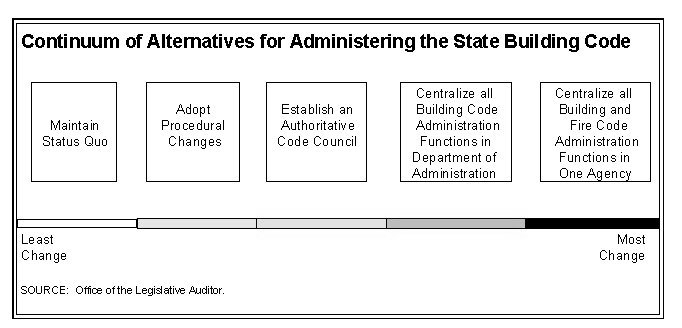
Maintaining the status quo will not address any of the problems that we identified, but one could argue that the problems currently encountered are relatively minor and do not warrant major changes. While the current system is complex and uncoordinated, agency staff have eventually resolved all major issues.
Procedural changes are improvements that the Legislature could make to the processes used to administer the building code. While they do not require any structural changes, they may help resolve many of the coordination problems that we identified. They include the following possibilities:
Several other states, including Connecticut, Iowa, Michigan, and Rhode Island, have implemented one or more of these procedures.
A third alternative that the Legislature could consider is to establish an authoritative code council rather than the advisory code council that currently exists. This option would create another level of government without substantially changing our current organizational arrangement. Its duties could include: determining whether building code problems are interdepartmental in nature; coordinating interdepartmental activities; approving building code provisions; resolving conflicts among agencies, codes, and building officials; reviewing proposed code-related legislative changes and reporting to the Governor on their merits; or entering into enforcement agreements. Several states, including California, use independent councils to assist with code development and enforcement.
Fourth, the Legislature could consider centralizing all building code activities by function within the Department of Administration, and requiring greater coordination between the departments of Administration and Public Safety. This would give the Department of Administration complete administrative authority over the building code, and would require moving code responsibilities out of the departments of Health and Public Service and the State Board of Electricity into the Department of Administration. Possible options to help ensure coordination between the departments of Administration and Public Safety could include incorporating some of the procedural options discussed previously. Several states with two agencies administering their building and fire codes, including Oregon and Rhode Island, have that responsibility shared between their housing and fire protection agencies.
Finally, the Legislature could centralize all building and fire code activities within one agency. These activities could be centralized in one of three existing agencies, the departments of Administration, Public Safety, or Commerce, or the Legislature could create an entirely new agency. Many states, including Connecticut, Wisconsin, and Ohio, have just one agency administering their building and fire codes--usually their housing, fire prevention, or commerce agency.
In our view, however, none of the five alternatives will completely alleviate all of the problems that we identified. Although some policy makers might favor centralizing all building and fire code activities within one or two agencies, we think that:
Building and fire officials bring different philosophies and priorities to code administration that no amount of reorganization can completely address. Our current organizational structure, although contentious at times, helps ensure that building and fire officials balance the building code’s various philosophies and goals: ensuring health and safety, providing uniformity, containing costs, and adhering to model codes. At the same time, we think that some procedural changes are necessary to improve how Minnesota administers its building code, especially as it relates to the fire code. At a minimum, we recommend that:
This would require coordination between building and fire officials and would ensure that both officials are involved throughout the code enforcement process. In addition, we recommend that:
The 1995 Legislature made a similar requirement of the departments of Corrections and Human Services regarding the adoption of licensing and programming rules for the residential treatment facilities that they both license.
Both these changes create a stronger building-fire partnership than currently exists and should help simplify the occupancy process for designers, builders, and building owners. Although opportunities for disagreement would still exist, these changes would require officials to address and resolve their differences much earlier in the process. At the same time, we recognize that building and fire officials might not always be able to reach agreement within a reasonable amount of time. We think that 10 working days should be sufficient for the building and fire officials to work together to come to a mutual agreement on the permits and proposed equivalencies. During this time, if the local officials are unable to resolve the conflicts among themselves, they could jointly meet with staff from the departments of Administration and Public Safety to help them reach a solution. Regardless of whether local officials jointly consult these state agencies, if the two officials are unable to come to an agreement after 10 days, we suggest that they present their cases to a state administrative law judge who will mediate the conflict and help the officials come to a mutual agreement. If a compromise cannot be achieved, the administrative law judge should have the authority to render a binding decision. According to staff in the Office of Administrative Hearings, administrative law judges frequently resolve disputes state agencies or local municipalities may have. Furthermore, the costs of using an administrative law judge should be shared by both public agencies and not the developer, regardless of the outcome.
Because we found fewer problems between the Department of Administration on the one hand and the departments of Health and Public Service and the State Board of Electricity on the other, we do not think that it is necessary to centralize all building code activities within the Department of Administration. However, we recommend that:
This procedural change would help simplify the promulgation process and would be consistent with how the electrical and plumbing provisions of the building code are currently developed and adopted. Also, this should help make it easier for building officials to enforce the code’s energy provisions.
In summary, the building code is a complex collection of overlapping provisions that apply differently throughout the state. Promulgating and enforcing those provisions are equally complex tasks. It is likely that philosophical differences between building and fire officials will persist regardless of how the building and fire codes are administered. However, our recommendations should help promote more consistent building code enforcement and help code-administering agencies better coordinate their activities.
More Information
The Program Evaluation Division was directed to conduct this study by the Legislative Audit Commission in April 1998. For a copy of the full report, entitled "State Building Code," (99-01), 83 pp., published on January 7, 1999, please call 651/296-4708, e-mail Legislative.Auditor@state.mn.us, or write to Office of the Legislative Auditor, 658 Cedar St., St. Paul, MN 55155.
Staff who worked on this project were Jo Vos (project manager), Judy Randall, and Jan Sandberg.

